











Loan Origination Software Checklist: 8 Must-Have Features
Introduction
Most loan origination systems look capable when an application follows the expected path. The real test begins when it does not. Buying a platform strictly from a feature list often misleads lenders. A system might process routine applications quickly, yet completely stall when an applicant submits incomplete documents.
Another software option may automate underwriting decisions smoothly, only to create severe accounting errors once approved files transfer into your servicing platform. Lenders, founders, banks, and credit unions must evaluate how technology handles real daily operations. Feature counts tell you very little about long-term software stability. Operators need to know if a platform maintains control when edge cases, policy overrides, and unexpected volume spikes hit the pipeline.
What Is Loan Origination Software?
Loan origination software manages the work required to move a borrower from application to an approved and funded loan. It brings borrower data, verification, credit rules, documents, and decision workflows into a structured process. During origination, lenders must collect accurate information, apply their credit policies, handle exceptions, and maintain a clear record of each decision. Loan origination software gives those activities a defined path while reducing the manual handoffs that can slow an application down.
Once funding takes place, servicing carries the loan forward. A well-designed origination process makes that transition easier by giving the servicing team a complete and reliable account from day one.
What Should Loan Origination Software Actually Do?
Stripped of complex terminology, an origination platform performs one fundamental task: it carries your lending policy into daily operations. The system acts as the operational bridge between a prospective borrower and a funded loan.
To fulfill that role effectively, software must execute a clear series of actions:
Capture intake data cleanly from every application channel.
Gather essential verification details from external credit bureaus and financial institutions.
Enforce programmed underwriting rules and risk parameters without variance.
Guide underwriters toward consistent, objective lending decisions.
Generate and store legally binding loan agreements and disclosures.
Push approved files smoothly toward cash or electronic disbursement.
Deliver an accurate, complete borrower profile to the servicing team.
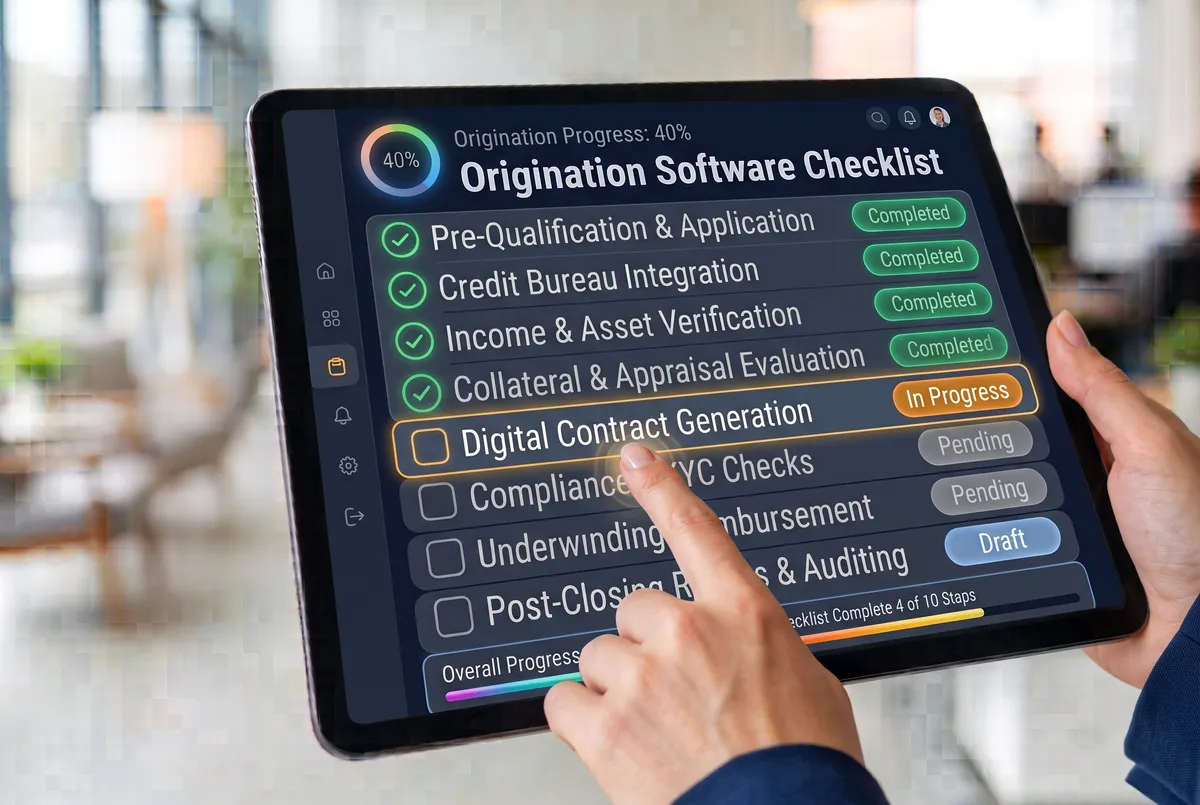
Loan Origination Software (LOS) Checklist: 8 Must-Have Features for Lenders
Evaluating loan origination software (LOS) requires looking at core capabilities. The right technology handles everyday application traffic easily while keeping complex files moving through your pipeline.
1. Configurable Application Workflows
Rigid systems force every applicant through identical steps regardless of loan type. That setup causes severe friction. A simple personal loan requires far less documentation than a complex commercial line. Modern software lets operators configure unique intake workflows, product-specific document rules, and conditional routing logic. Clean files advance automatically. Complex applications detour directly to senior underwriters. A clean file and an exception case should never take the same path through your organization.
2. Automated Underwriting and Decisioning
Speed matters, but operational consistency keeps lenders profitable over time. Automated decisioning engines apply your exact credit policies across every incoming application. The software evaluates debt ratios, credit scores, and income thresholds without personal bias or human error. Automation should enforce your credit policy, not invent it. Routine files receive instant decisions, while borderline cases route directly to human underwriters. This structure maintains strict underwriting discipline across all application volumes.
3. Third-Party Data Integrations
Few lenders can make a sound credit decision from application data alone. Credit bureaus, identity verification services, banking data, fraud tools, and other providers may contribute information during review. Direct integrations bring those inputs into the process when decision-makers need them. Without reliable connectivity, staff may end up checking separate systems or waiting for data before an application can move. That delay matters when borrowers are also comparing other offers.
4. Document and Disclosure Management
Approval creates paperwork with consequences. Loan agreements, required disclosures, electronic signatures, and supporting documents need to stay connected to the correct application. Strong document management provides lenders with a reliable record of what was generated, delivered, and accepted during origination. Compliance teams also need those records later. Hunting through inboxes or separate storage systems to reconstruct a loan file wastes time and creates questions that a complete record could answer immediately.
5. Exception and Manual Review Management
The happy path tells you how software was designed. Exceptions show whether it can survive a lending operation. Missing documents, conflicting information, unusual borrower circumstances, and policy referrals all require somewhere to go. Loan origination software should identify cases that need attention and route them to the appropriate reviewer without losing their history. Experienced underwriters can then focus on cases where judgment matters, rather than spending their day finding applications that fall outside an automated workflow.
6. Funding and Payment Connectivity
An approval still has to be converted into a funded loan. Once the required conditions are met, the system must support the movement toward disbursement while maintaining an accurate record of what occurred. Funding information should remain tied to the borrower and loan record rather than becoming another disconnected transaction. Clean records at this stage matter because servicing will soon inherit the account, including the balances and transaction history created during origination.
7. Reporting and Origination Visibility
Where are good applications being lost? Approval rates alone will not answer that question. Managers need visibility into application volume, conversion, decision outcomes, referrals, processing times, and points where cases stop moving. Product-level reporting can reveal another layer by showing how different parts of the lending operation perform. Useful reporting via loan origination software turns origination activity into something teams can investigate. Patterns often expose a policy issue, workflow problem, or operational bottleneck before anecdotal feedback does.
8. Servicing and System Connectivity
Origination ends. The loan does not. Once funds move, servicing teams need the borrower record, loan terms, documents, transaction details, and account history created upstream. Poor handoffs force staff to re-enter information or reconcile records between systems. Broader connectivity also matters when the loan origination software works alongside payment providers, communication tools, reporting systems, and other lending technology. A strong setup keeps the loan record intact as responsibility moves from acquisition and origination into ongoing account management.
Questions to Ask Before Choosing a Loan Origination Software (LOS)
Do not evaluate loan origination software only through a perfect demo application. Real lending operations are full of exceptions, policy changes, missing information, and sudden shifts in volume. Ask the vendor to show how the system behaves when the easy path breaks.
Use these questions to put the platform under some pressure:
What happens when borrower data is incomplete? Follow an exception from the application queue through manual review.
How quickly can we change a lending rule? Find out whether your team can adjust criteria without a lengthy development cycle.
Where does borrower data travel? Trace information from application and third-party sources through decisioning, funding, and downstream systems.
Can we reconstruct a decision later? Review the audit trail for a completed application and see what your compliance team would actually receive.
Can different products follow different rules? Test separate criteria, workflows, documents, and approval paths.
What happens after funding? Examine how the completed loan and its records move into servicing.
Will the process hold up at twice the volume? Growth should test capacity, not expose an operation built around manual workarounds.
A polished demo shows what a loan origination software can do. A difficult scenario tells you how it will behave when your lending team actually depends on it.
How Infinity Supports Loan Origination
Infinity Software gives lenders the tools to manage origination without separating it from the rest of the loan lifecycle. Borrower applications, verification, documents, configurable workflows, and third-party integrations stay within one lending environment.
Approved loans can move from funding into servicing with the borrower and account records already in place. Reporting keeps teams informed as applications move through the process. For lenders, that means fewer operational handoffs and a clearer path from the first application to the ongoing loan relationship.
Looking Forward
Choosing a loan origination software is easy when every application behaves exactly as expected. Lending rarely gives you that luxury. The real measure of a system appears when policies change, applications need extra review, volume increases, or a funded account moves into servicing. Those moments reveal whether the technology fits the operation or forces the operation to work around it. Look beyond the feature count. Choose a loan origination software that can carry your lending rules, data, and decisions through real operating conditions while giving the business room to grow.






 <
<