











Loan Origination Best Practices: Step-by-Step Guide
Gone are the days when loan origination was just a starting point of a lending cycle. The lending market in particular, and fintech in general, has evolved dramatically. Lending operations have become more swift and automated. With this automation in lending activities, loan origination software has become a defining factor in how efficiently a lending institution operates and scales.
Evidently, delays, manual handoffs, or fragmented decision-making add measurable cost to the business. And this is exactly where loan origination comes into play. Designed and implemented correctly and with due care, LOS transforms the entire trajectory of the lending cycle.
Given that, in this article, we will:
Discuss loan origination best practices.
Outline how lenders can pivot lending operations with precision.
And how they can sustain operational confidence.
A Step-by-Step Guide to Loan Origination: From Application to Disbursement
1. Start with a Frictionless, Data-Driven Application Intake
Many lenders assume that inefficiencies come later, somewhere in the lending cycle. But the whole concept of smooth sailing gets flawed at the top if application intake is not frictionless. Remember, inefficiency often enters at the first interaction, i.e., the loan application. Because it sets the tone for the entire origination process, frictions in the application process clearly indicate the poor design of a loan origination software.
This is why frictionless application intake matters
Application friction reduces conversion rates
Manual or incomplete submissions increase staff workload
Delays at this stage raise customer acquisition costs (CAC) and opportunity costs
Role of Loan Origination Software
A well-developed loan origination software sets the standard for the entire loan cycle. The more efficient it is, the more conversion rates can be ensured. At present, in many cases, manual resources are at play. While loan origination software validates entries in real-time to reduce manual intervention.
Results? The software reduces the operational drag early in the cycle and lowers the cost per loan by minimizing staff effort on corrections
2. Standardize Data Collection Without Sacrificing Flexibility
Next comes the inconsistent data collection that can erode efficiency to a much greater extent. Ad-hoc or incomplete data collection often results in rework and slow decision-making. Lenders or institution teams can undo that pattern by implementing configurable data fields tailored by loan type, geography, and risk tier. Also, defining rule-based document requirements allows lenders to ensure all submissions are complete and compliant.
And besides that, standardizing data collection matters because
Rework due to inconsistent data delays the loan approval cycle.
Manual verification increases staff workload and operational cost.
Delayed or inaccurate data reduces overall efficiency and borrower satisfaction.
Well-coded loan origination software plays a critical role in standardizing data collection. From enforcing clean and structured data to automating validation checks, loan origination software provides ready-to-use numbers and analytics.
Doing this helps businesses improve consistency across all applications. Lenders also have an edge in minimizing operational waste by preventing repeated verifications.
3. Automate Eligibility Checks and Pre-Screening Early
Applications should be reviewed thoroughly, but not all applications entering the pipeline deserve deep human review. This early screening helps underwriters save a lot of wasted effort. When eligibility checks are automated, only qualified applications move forward, hence reducing wasted effort and improving throughput.
Automation, in this regard, is necessary because:
Manual screening consumes valuable underwriter time.
Delays in filtering ineligible applications increase cycle time and operational cost.
Inefficient pre-screening reduces the number of qualified applications processed per day, limiting loan volume growth.
What can lenders do to save on operational costs?
For lenders to have a comparative advantage, they should not just limit themselves to implementing automated eligibility checks. They are also required to design rules to reflect multiple loan products or risk tiers, ensuring flexibility while maintaining consistency. And for that to happen, they have to utilize loan origination software. This is because LOS applies consistent decision logic at scale, ensuring every application is evaluated against the same rules.
As a result, organizations save staff time and improve loan flow by giving precedence to qualified applications.
4. Streamline Credit Assessment with Configurable Risk Rules
The process does not end here. After eligibility checks come credit assessment and risk evaluation. Lenders and decision-makers might know how manual underwriting directly contributes to inconsistent decision-making and lethargic review cycles. However, the dilemma can be changed. By configuring risk rules, lenders can make faster decisions, reduce overall operational costs, and allocate resources where they are needed most.
A modern loan origination software may be the sole answer to all the hurdles. The software automates credit scoring and rule-based assessments. This, as a result, ensures consistency across all applications and eliminates any ambiguities in the approval.
Business Impact
That said, loan origination software helps lenders grow their business as it does the following:
Speeds up approvals, improving turnaround time.
Reduces operational cost per application by minimizing manual review.
Enhances portfolio quality and reduces risk-related financial loss, contributing to better ROI.
5. Enable Parallel Processing Instead of Sequential Workflows
Although automated credit assessment speeds up the process, a linear or sequential workflow can still kill the process’s momentum. This approach does not create huge gaps but can significantly alter the swift trajectory of the loan cycle. The solution lies not only in automation. The real solution lies in parallel processing. For instance, if loan application, risk assessment, and compliance checks occur simultaneously in the cycle, lenders can dramatically accelerate the origination process.
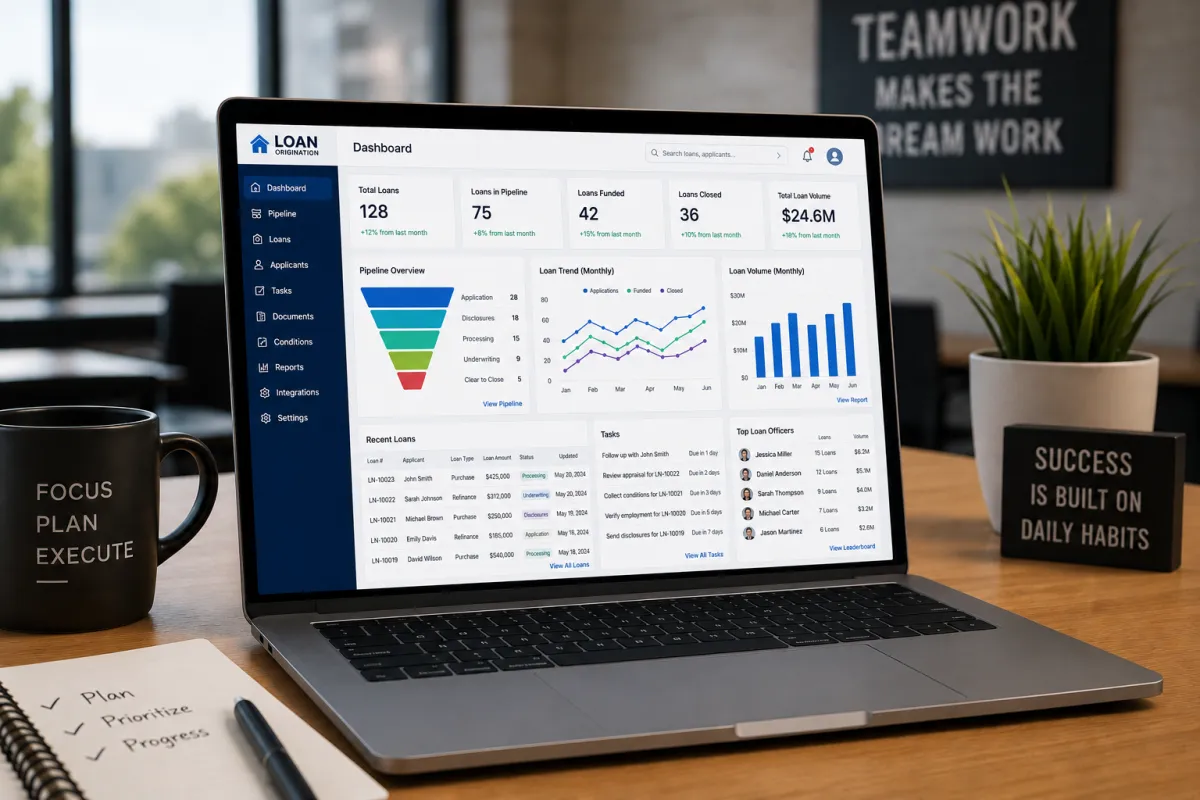
Loan origination software, in this regard, helps coordinate parallel tasks across teams in real-time. From tracking dependencies and providing alerts to giving managers a dashboard to analyze the loan pipeline, loan origination software ensures that parallel workflows run smoothly and consistently across loan types, branches, and risk tiers.
Business Impact
Shortens the loan cycle time without adding additional staff.
Increases throughput per underwriter or processor, improving efficiency metrics.
Reduces operational friction, freeing teams to focus on high-value tasks instead of administrative bottlenecks.
6. Embed Compliance into Every Step
The next critical yet simple step is to embed compliance into every step of the workflow. Lenders know that institutions or organizations cannot work in a silo. They have to ensure that all the processes adhere to regulatory measures. The goal is not just ensuring compliance. The goal is to do this without slowing the origination process. Waiting until post-approval to verify regulatory requirements creates rework, increases operational risk, and can lead to costly penalties.
Best Practices
Implement automated rule-based compliance checks at every stage of origination.
Maintain audit trails and regulatory reporting integrated directly into workflows.
Design workflows that flag exceptions in real-time, preventing non-compliant applications from proceeding.
Loan origination software, as it were, helps lenders automate rule-based compliance checks. Doing this results in reduced human error and violation risks. For instance, the software automatically generates reports, hence making it easier for teams to demonstrate adherence to regulators and internal standards.
7. Maintain Transparency with Borrowers
The success of a lending business depends on how satisfied the borrower is with your services. Know that even a smooth origination process can be undermined by poor communication with borrowers. This is because poor communication increases support requests, and a lack of transparency can lead to application drop-offs.
The best step lenders can take to avoid that from happening is to provide automated status updates via portal, SMS, or email at every major stage. Lenders should also offer self-service tools for document upload and transparent communication.
Role of Loan Origination Software
The software ensures that an automated notification is sent to the borrower for major updates.
It tracks engagement and document submissions on real-time dashboards.
Consequently, this automation not only reduces support cost per loan but at the same time also improves loan completion rates and overall borrower satisfaction.
8. Automate Approval, Documentation, and Disbursement
This brings us to the final step of the loan origination process. Lenders must take due care at this stage. Manual handling at this stage usually results in unwanted consequences such as delays, errors, and operational overheads. That, in turn, finally leads to poor borrower experience and internal inefficiencies.
However, with automated workflows for approvals, digital documentation, and integration with payment gateways, lenders can completely change the lending landscape of the disbursement process.
Conclusion
Loan origination is no longer a back-office function. Instead, it is a strategic engine that determines how fast, compliant, and profitable a lending operation can be. From the first borrower interaction to final disbursement, every step in the origination process either compounds efficiency or multiplies friction.
The best practices outlined in this guide show a clear pattern: lenders who modernize their workflows with loan origination software gain more than speed. They gain control. By standardizing data, automating eligibility and risk assessment, enabling parallel workflows, embedding compliance, and maintaining borrower transparency, organizations transform origination into a competitive advantage rather than a cost center.






 <
<