











How Loan Management Software Streamlines Loan Origination
When it comes to fintech, capital is hardly the problem lenders face. They may have plenty of it. The problem arises when their processes cannot keep up with their ambition. In this fast-paced technological era, borrowers can apply for loans with as many lenders as they like. Speed and certainty have become the true currencies of trust. If your loan origination process is slow, relies on manual labor, and is fragmented across spreadsheets, you are likely losing customers to your competitors.
Specifically, for small- or mid-size lenders, maintaining origination efficiency is no longer a viable option. It is the front line of growth. The more efficient, swift, and certain it is in nature, the better. In this article, we will outline:
How manual origination disrupts lending operations.
And how loan management software rebuilds the origination engine.
The Hidden Cost of Manual Origination in Small Lending
When organizations rely on manual origination, everything seems good on the surface. Applications come and are dealt with accordingly. But what is usually at peril against this backdrop is that every spreadsheet, every email thread, and every PDF attachment adds decision latency, and latency is expensive in lending. So, what feels like minor operational drag compounds into days of lost momentum. Other factors that affect lending operations in small organizations include:
Increased structural cost as processes scale linearly with volume. This means that the more applications come in, the more underwriters a business needs to hire.
Misalignment in information owing to disconnected and fragmented data across spreadsheets, PDFs, and shared devices. Hence, portfolio risk creeps in.
What “Streamlining” Actually Means in a Lending Context
Contrary to hyped-up assumptions, streamlining is not all about faster approvals. Lenders may argue here that speed is just a formality if the entire lending operation is functioning in isolation. So, in true essence, streamlining is about building an origination process that is not only fast but also repeatable, auditable, and scalable.
Repeatability in origination means that no two borrowers receive the same origination. Most of the time, when data is not connected and working in isolation, different borrowers may receive different decisions, not based on policy. But because the business is solely relying on isolation.
Auditability is the ability of lenders to explain to concerned authorities exactly when and why a loan was approved or declined.
And lastly, scalability. "Scalable" means you can increase volume without increasing chaos or headcount at the same rate.
How Loan Management Software Rebuilds the Origination Engine
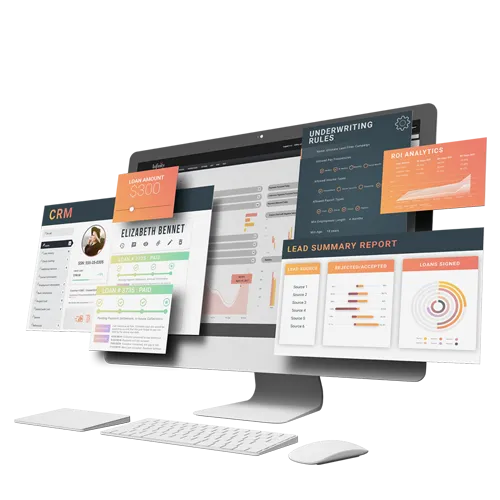
For small lenders, loan management software is not just adopted to ensure automation. Instead, it is utilized to overcome manual pitfalls, littered email inboxes, fragmented spreadsheets, and manual judgment with a single, decision-focused system that turns origination into a repeatable growth engine.
Centralized Digital Intake
The first impression a borrower has of your institution is the application process. On the borrowers’ end, applications are partial in nature, and where manual processing is the norm, follow-ups happen over email.
Loan management software, in this regard, provides a complete borrower portal for borrowers to upload documents, check their status, and sign disclosures. For instance, you receive ten document requests across multiple channels. Now, with loan management software, the lender provides a centralized user portal to deal with multiple requests.
However, it should be noted here that not every borrower is the same. With adaptable and smart forms, an optimized loan management software portal uses conditional logic to adapt the application in real-time. This, in turn, allows small lending owners to save on manual headcounts and a plethora of human errors.
Automated Data Verification
Unlike large-scale lenders and lending systems, small lenders cannot afford to make a loan based on fraudulent or misinterpreted data. And that usually happens when underwriters spend hours or days verifying the borrower's application. Well-configured loan management software plays here as a catalyst for growth and efficiency, such as
API-Driven Source Truth: For small lenders, the shift from borrower-provided documents to system-provided data is critical. Loan management software, to make this process less concerning, pulls the borrower data directly from their bank account by integrating financial data aggregation APIs such as Plaid and Finicity.
Implementing such integration practices offers lenders a real-time analysis of the Debt Service Coverage Ratio (DBCR). Also, the LMS software ensures that the risk of ‘doctored’ bank accounts, common in B2B operations, is virtually eliminated.
Automated KYC/AML: Because small lenders usually lack large-scale compliance departments, automated verification ensures duly compliant lending activities, hence performing deep background checks in milliseconds. For instance, the loan management software screens the watchlist, instantly flagging if a borrower is a Politically Exposed Person (PEP) or named under a global sanction list.
Embedded Credit Rules & Risk Logic
While exceptions are always there, in many small lending firms, credit policies are just a part of a static PDF, or worse, as a collection of unwritten rules living in the heads of senior loan officers. Well-coded loan management software saves the unnecessary hassle, such as:
The lenders can programme the LMS in a way that it automatically flags applications as rejected or accepted. The LMS, in turn, instantly filters out applications that fail your non-negotiables. So, be it a minimum FICO (a financial analytics company) threshold or mandatory requirements, the loan management software handles the rejection seamlessly.
Apart from that, the loan management software for small lenders allows for deep insights into credit scoring. It calculates a consolidated "Risk Score" instantly, giving the underwriter a standardized benchmark for every deal.
This enables:
Auto-approvals for low-risk profiles
Auto-declines for out-of-policy applications
Structured exception handling for edge cases
Workflow Orchestration
In layman's terms, workflow orchestration is the automated management of interlinked tasks and applications from start to finish.
The problem that small lenders usually face is process entropy. And that is also the biggest threat to productivity. Apparently, when the team is small, everyone tries to do everything, resulting in queue blindness. No one knows where a file is or who is working on it. A loan management software ensures that everything is routed in a composed and scheduled way. For example, LMS software can automatically route applications based on the complexity of the deal or the seniority of the staff.
Routing done, the loan management software orchestrates the parallel processing. While the underwriter is reviewing the business plan, the LMS is simultaneously pulling the credit report, running AML background checks, and pinging the Secretary of State for business standing.
Economic Impact: What Changes in the Profit and Loss
This section is designed to show the reader exactly how LMS transforms their financial standing by shifting their unit economics from fixed to variable costs.
Cost-per-Decision Goes Down
With loan management software in practice, small lenders not only save consumptive resources but also allow underwriters to focus on judgment instead of administration. This implies that LMS software helps small lenders process more applications with the same headcount. Hence, lenders’ cost per decision drops, and operating leverage improves.
Driving the Conversion Rate Up
With a mere 30-second attention span, people hardly wait to get approvals. Similar is the case with lending operations. Borrowers do not just choose the lender with the best rate. They go for speed and certainty. A 48-hour delay in your response is an invitation for them to sign with a faster competitor. Thus, loan management software speeds up the process and eventually improves the customer acquisition cost, let alone avoiding a financial quagmire.
Time-to-Funding Shrinks
Using a loan management system drastically improves the capital velocity (return per unit time). For a small lender, being able to turn your capital 5 times a year instead of 3 times significantly increases your total annual yield.
Conclusion
From everything that has been stated above, it is easy to deduce that borrowers no longer differentiate between big and small. They differentiate based on how ‘slow’ or ‘fast’ a business is. That is when loan management software comes into play. From centralizing data into a single unit, embedding credit policies to ensure smooth sailing, to workflow orchestration, LMS software takes care of everything in between. In 2026, the lenders who thrive will not necessarily be the ones with the largest balance sheets but the ones with the most efficient engines.
Book a Demo Today to see how we can help you shrink your time-to-funding, eliminate queue blindness, and scale your portfolio with confidence.






 <
<